


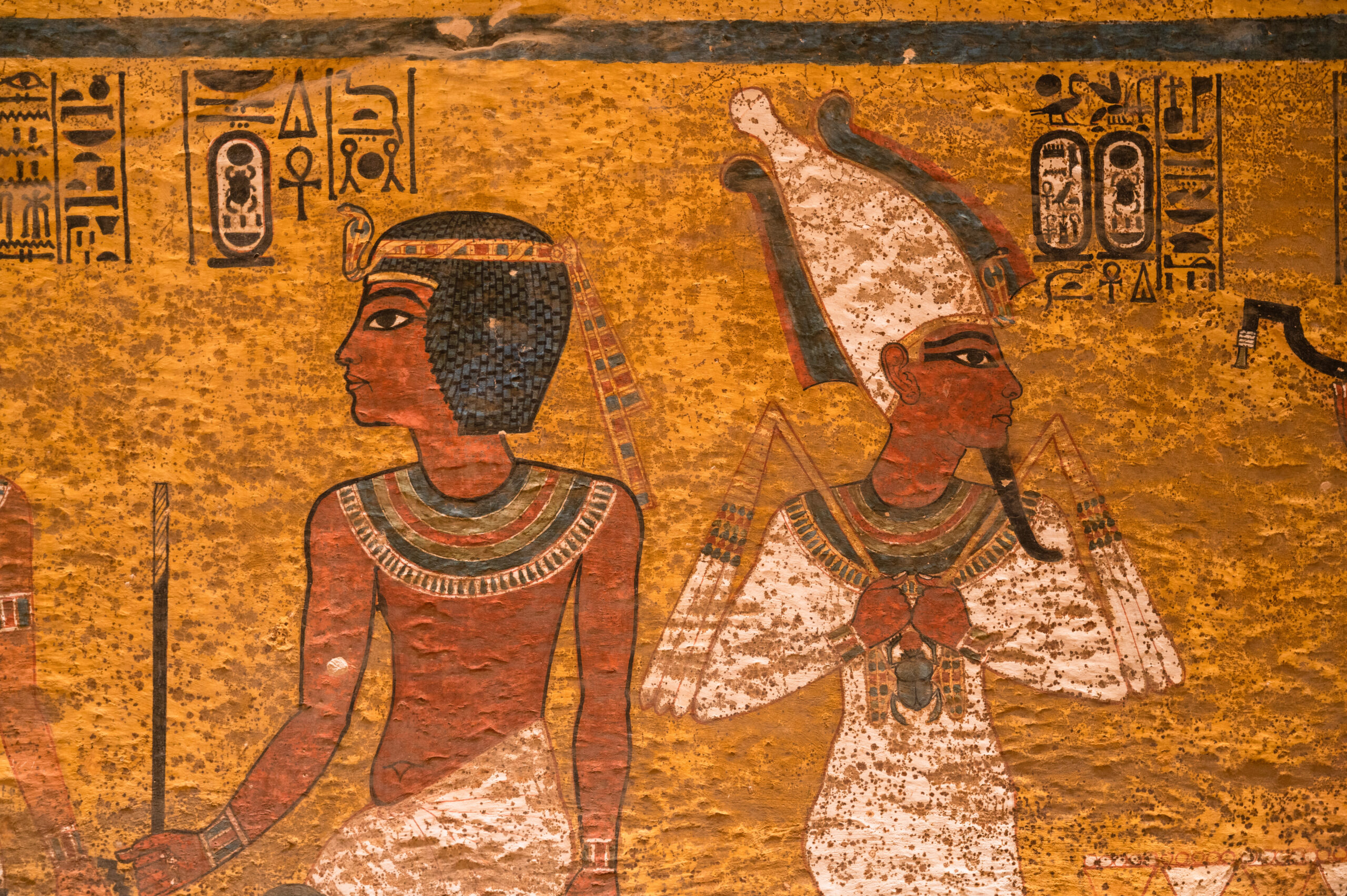
In Egypt’s Valley of the Kings, carved into the fragile shale cliffs of Luxor, lies one of the world’s most celebrated discoveries: Tutankhamun’s tomb.
Known as KV62, the burial chamber of the boy pharaoh has captivated the world since its discovery by Howard Carter in 1922. But behind the golden artefacts and painted walls, a structural crisis has been quietly developing for decades, threatening the long-term resilience of this ancient site.
A major fault runs across the ceiling of the burial chamber. Cracks have widened. As extreme weather events become more frequent globally, the environmental risks to our cultural heritage escalate; flash floods, including a significant event in 1994, have forced water deep into the rock. And the Esna shale in which the tomb is carved is soft, moisture-sensitive, and prone to swelling – is under increasing strain.
Now, a new study by Professor Sayed Hemeda of Izmir Institute of Technology (IZTECH), Turkey, is using modern geotechnical engineering, including Seequent’s PLAXIS 3D, to provide a detailed picture of the structural risks and to chart a clear path forward for the tomb’s long-term preservation and resilience.
Professor Hemeda’s work extends well beyond Tutankhamun’s tomb; his application of advanced geotechnical modelling has already revealed hidden structural risks beneath Pompey’s Pillar in Alexandria, establishing a replicable methodology for safeguarding vulnerable heritage sites across the world.
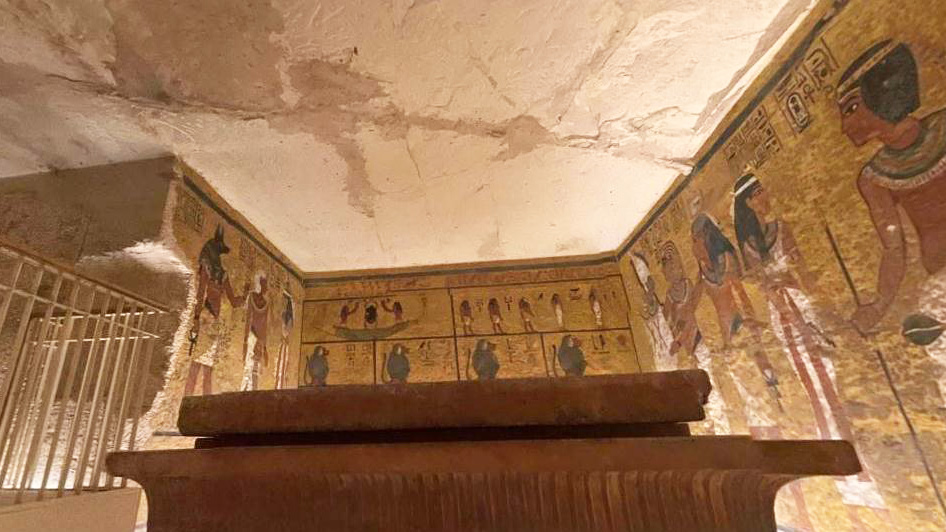
This photo shows the major fault running across the ceiling of King Tutankhamun’s burial chamber.
Source: Professor Sayed Hemeda
Building resilience in KV62: the structural challenge
Tutankhamun’s tomb is situated in a challenging geological setting. The surrounding Esna shale has a uniaxial compressive strength of around 10–12 MPa, rock that is technically ‘poor’ by engineering classification, under constant pressure from the weight of the mountain above.
Water has made things significantly worse. Rainwater and flood events have penetrated the rock over centuries, raising humidity levels and causing the shale to expand and contract. This repeated cycle of swelling and shrinkage has progressively widened the fault running through the ceiling of the antechamber and burial chamber – the same ceiling that carries the famous painted scenes of Tutankhamun’s journey to the afterlife.
‘The combination of a major ceiling fault, water infiltration, and the inherent weakness of the Esna shale has made Tutankhamun’s tomb one of the most structurally vulnerable in the Valley of the Kings,’ Professor Hemeda said.
Without intervention, the study warns that progressive deterioration of the ceiling could eventually compromise the structural integrity of the chambers themselves and with it, the irreplaceable wall paintings they contain.
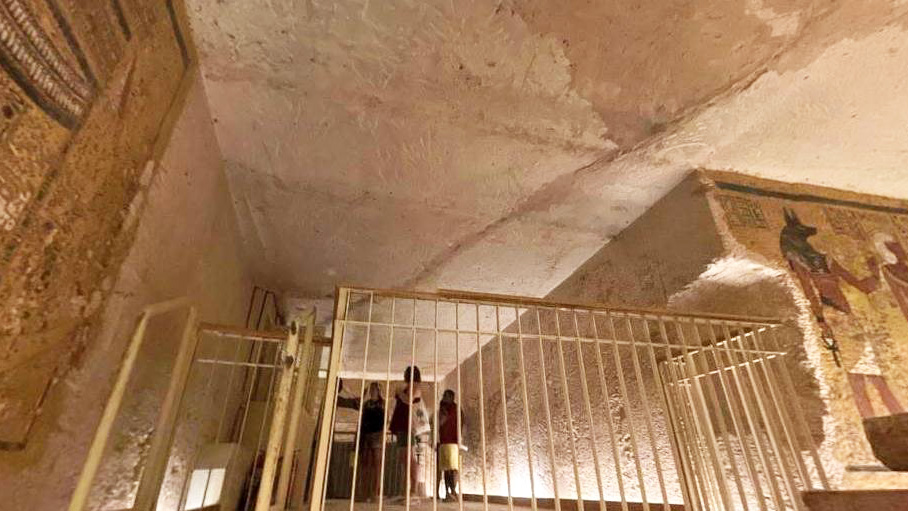
Cracks in the ceiling of King Tutankhamun’s burial chamber have widened over time. A new study by Professor Sayed Hemeda has provided a clear picture of the risks and the path forward to preserving the ancient site.
Source: Professor Sayed Hemeda
PLAXIS 3D: the modelling tool at the centre of the analysis
To assess the tomb’s condition without disturbing the sensitive archaeological site, Professor Hemeda turned to advanced numerical modelling using Seequent’s PLAXIS 3D.
Using the Mohr-Coulomb elastoplastic model with site-specific material parameters derived from laboratory testing and borehole logs, Professor Hemeda built a detailed three-dimensional simulation of the tomb, incorporating the burial chamber, antechamber, corridors, and the major fault zone intersecting the ceiling. The model was used to quantify exactly what is happening structurally – and what would happen after different intervention strategies were applied.
The results were striking. The analysis revealed critical stress concentrations, particularly in the ceiling and crown zones around the major fault. By simulating the installation of a rock bolt reinforcement system – fully grouted GEWI Threadbar bolts installed in a systematic grid pattern – the model demonstrated significant improvements across every key structural measure:
- Effective mean stress reduced by 54.4% (from −695.84 kN/m² to −317.32 kN/m²)
- Vertical stress on the ceiling reduced by 53.7% (from −1,600 kN/m² to −740.06 kN/m²)
- Relative shear stress reduced by 91% (from 1.0 to 0.09), dramatically reducing the risk of shear failure along the fault
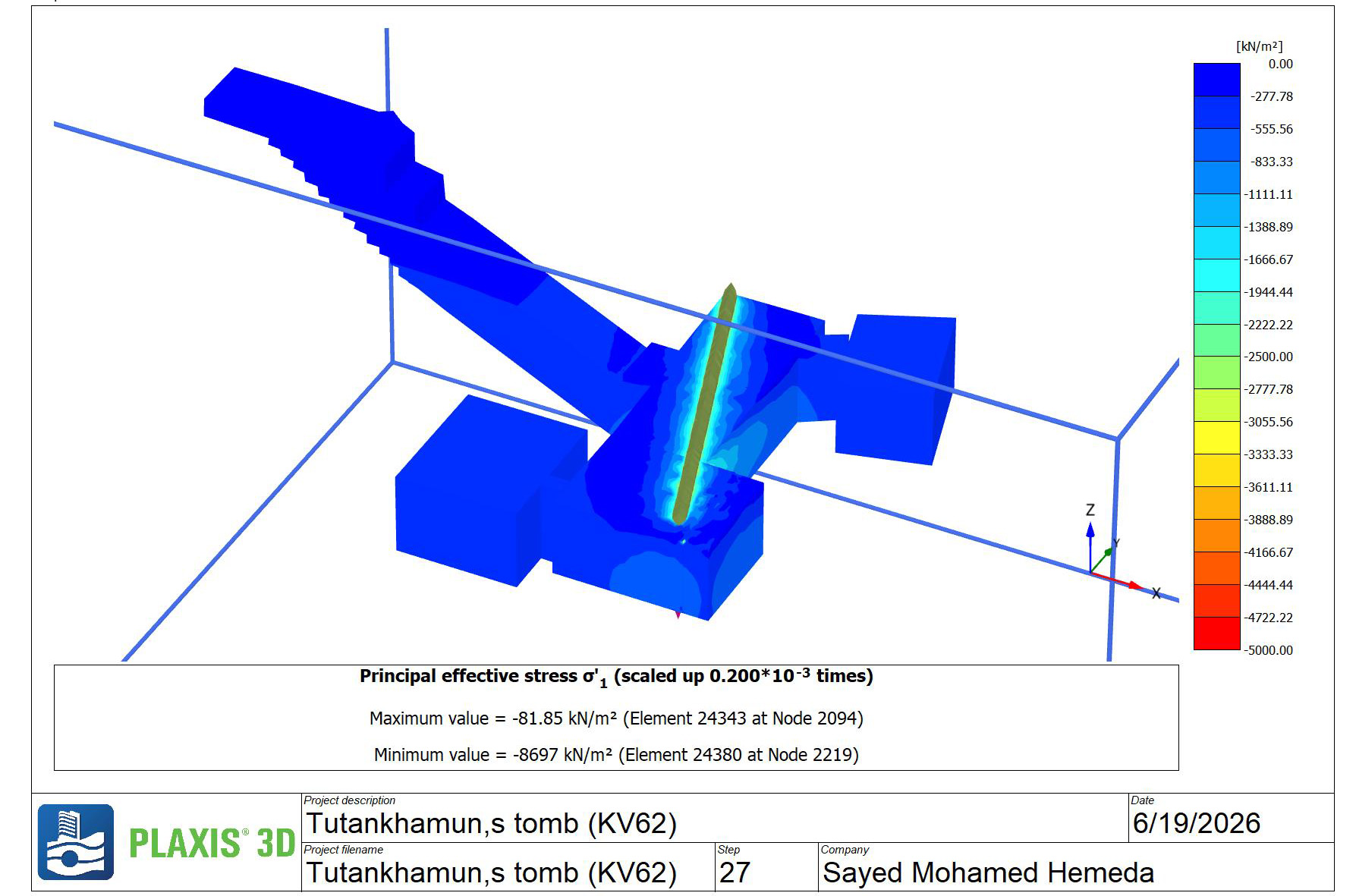
The impact of the major fault on the stability of Tutankhamun’s tomb. The maximum value of the principal effective stresses is 8.697MPa.
Source: Professor Sayed Hemeda in PLAXIS 3D
Understanding the reinforcement mechanism
While installing rock bolts introduces a minute, calculated amount of movement in the rock mass, this is a fundamental part of how the support system works. Rock bolts act as passive support elements, generating their stabilising force through a small, controlled deformation.
This initial movement mobilises the tensile capacity of the bolts, transforming a series of potentially unstable blocks into a more coherent, self-supporting structure. The advanced modelling proves that facilitating this safe, controlled deformation is the key to preventing the catastrophic, progressive structural failure that would otherwise occur.
‘The numerical model demonstrates a successful transition from a state of high structural vulnerability to one of enhanced stability and safety,’ Professor Hemeda said.
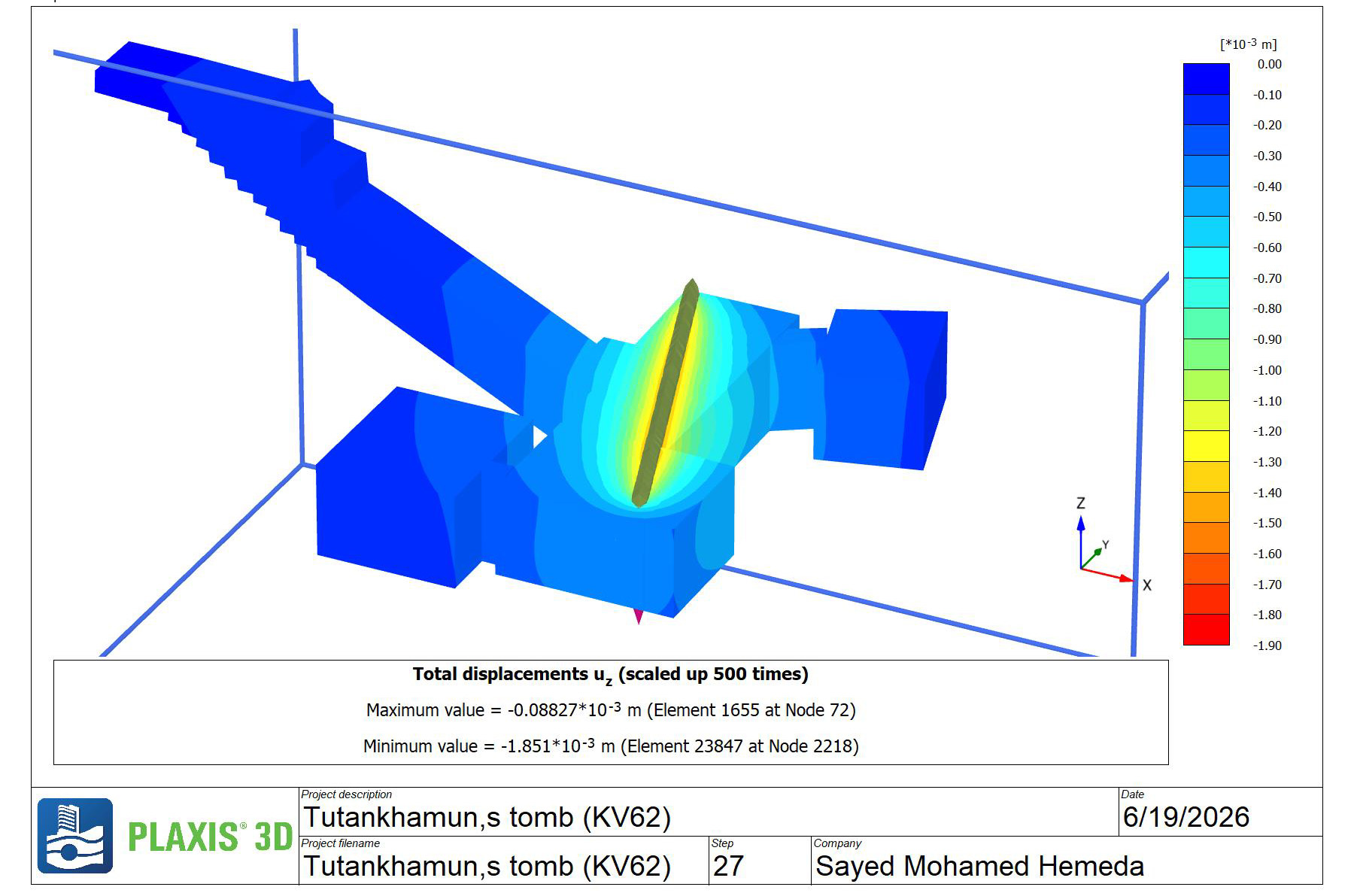
The impact of the major fault on the stability of Tutankhamun’s tomb. The maximum value of the total displacements Uz is 1.85 mm.
Source: Professor Sayed Hemeda in Plaxis 3D
A roadmap for preservation
The study goes beyond diagnosis. Based on the Rock Mass Rating (RMR) system – which classified the Esna shale surrounding KV62 as ‘poor rock’ with a score of 40 – Professor Hemeda proposes two practical support system options for the antechamber and burial chamber.
Both options centre on a systematic installation of 20 mm diameter, fully grouted rock bolts, 5 metres long, spaced at 1.0–1.5 metre intervals in the crown and walls, combined with wire mesh and shotcrete. The study calculates that 23 roof bolts would be sufficient to provide the required structural resistance across the exposed area of the chambers – a remarkably precise engineering specification derived directly from the numerical model.
Critically, the study also establishes strict displacement thresholds for post-installation monitoring: a maximum allowable vertical displacement of 1 mm over six months, with a warning threshold of 0.5 mm in any three-month cycle. These figures provide conservators with a clear, quantitative framework for ongoing structural health monitoring – and an early warning system if conditions change.
Tutankhamun’s tomb lies in the Valley of the Kings, west of Luxor.
Source: Google Maps
The wider significance
Professor Hemeda’s work on KV62 is part of a broader body of research applying advanced geotechnical modelling to cultural heritage preservation – a field where the stakes could not be higher and the opportunity for physical investigation is tightly constrained.
His work has also revealed hidden structural risks beneath Pompey’s Pillar in Alexandria. In each case, the principle is the same: where archaeologists cannot excavate and engineers cannot drill without consequence, high-fidelity digital simulation provides the evidence base for responsible decision-making.
Crucially, the digital simulation techniques used to safeguard these priceless antiquities – predicting subterranean risks before they happen – are the exact same principles used to build resilience into modern, everyday infrastructure across the globe. By understanding the subsurface, we can engineer solutions that withstand environmental pressures.
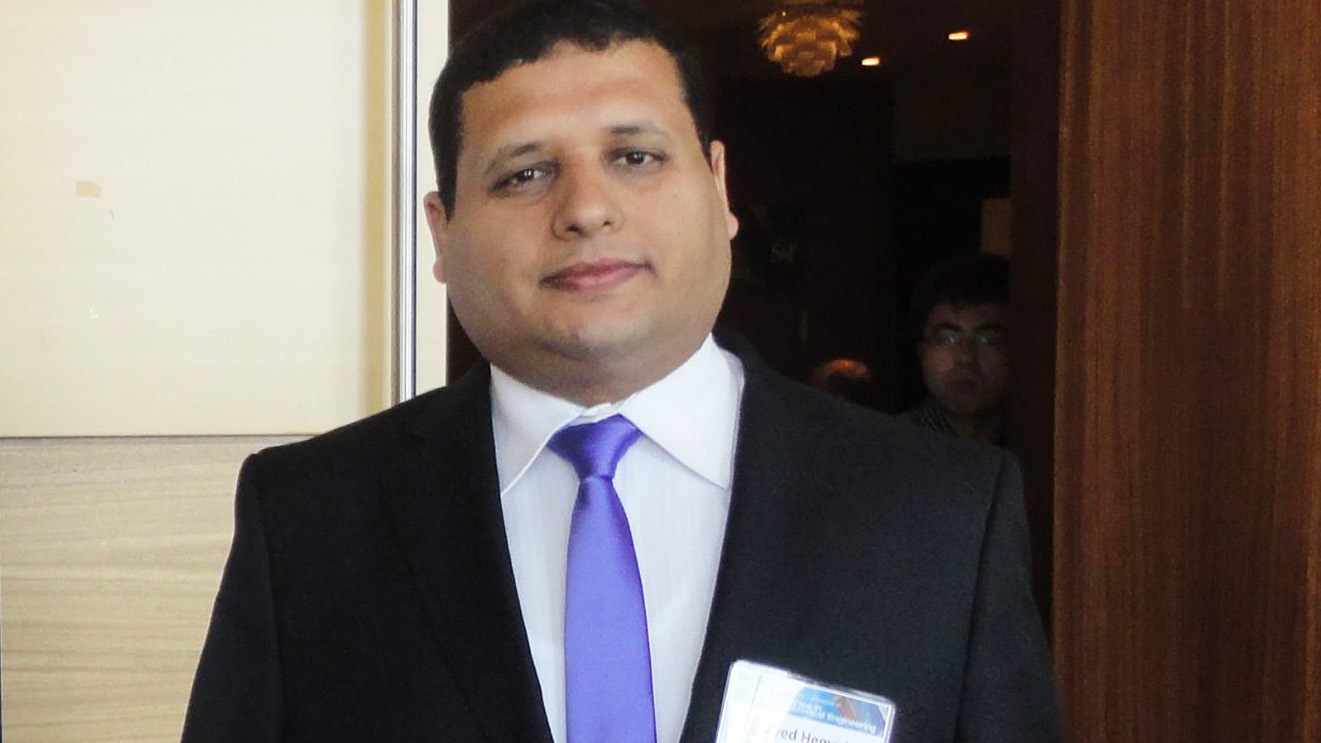
Professor Sayed Hemeda
Source: Supplied
For Tutankhamun’s tomb, that evidence base is now considerably stronger. The PLAXIS 3D analysis points to the rock bolt reinforcement as a viable, non-invasive and structurally effective solution – one that can be precisely designed and continuously monitored to protect the tomb’s integrity without compromising its archaeological significance.
Seequent Segment Director Civil Pat McLarin said Professor Hemeda’s work showcased how digital tools and geotechnical engineering support better decision-making across diverse ground engineering challenges.
‘PLAXIS 3D allows us to understand complex subsurface behaviour with a level of clarity that simply wasn’t possible before. In heritage contexts like KV62, that means informed decision, minimising invasive activities to protect priceless cultural heritage while managing real structural risks,’ he said.
The boy pharaoh’s final resting place has survived more than three thousand years. Modern geotechnical engineering is helping to ensure it survives the next three thousand.
- Hemeda, S. (2025). 3D stability modelling of Tutankhamen’s Tomb (KV62) using PLAXIS 3D with jointed rock model. npj Herit. Sci. 13, 155.
- Hemeda, S. (2026). Numerical analysis and validation of rock bolts installation for structural stabilizing of Tutankhamen’s Tomb. npj Heritage Science, 14, 304.