


By Paul Gorman
The failure of two tailings dams in Brazil within five years prompted the government and mining industry to act on the risks posed by ageing, upstream-raised tailings structures.
The Brumadinho Dam failure and mudflow in 2019 claimed 270 lives, four years after 19 people died in the Mariana Dam disaster. Both occurred in the state of Minas Gerais, about 150km apart.
Minas Gerais has more tailings dams than anywhere else in Brazil. Following Brumadinho, the National Mining Agency identified 221 registered dams in the state, 42 of which were classified as high risk that required urgent attention to reduce the potential for failure.
In the municipality of Congonhas, also in Minas Gerais, engineering company Intertechne used Seequent’s Leapfrog and PLAXIS 2D and 3D software to design a R$5 billion (US$962.3 million) project to decommission a tailings dam on about 250,000 sqm of terrain by the end of 2035.
Why Brazil is decommissioning upstream tailings dams
Following the Brumadinho tailings dam collapse, Brazil’s National Dam Safety Policy legislated for these structures to be decommissioned to protect public and environmental safety.
Upstream tailings dams were built by constructing successive retaining walls on top of older, uncompacted mining waste which was often saturated.
They were inexpensive to build but very fragile and vulnerable to heavy rain or earthquake shaking, both of which could turn loose sediments into liquid and cause them to collapse.
Intertechne Senior Project Geologist, Andrés Miguel González Acevedo, said this project’s main objective was to ‘eliminate a critical environmental liability’ and meet legal requirements by building a robust reinforcement embankment.
‘The relevance of the project is reinforced by the serious accidents that occurred in Brazil with upstream-raised dams.
‘At the end of the implementation, the complete elimination of an environmental liability is expected, with the safe reintegration of the area into the environment, without remaining socioeconomic or environmental risks.’
The project team assessed and modelled the dam’s foundations and surroundings, which allowed for the accurate replication of its geological and geotechnical structures, he said.
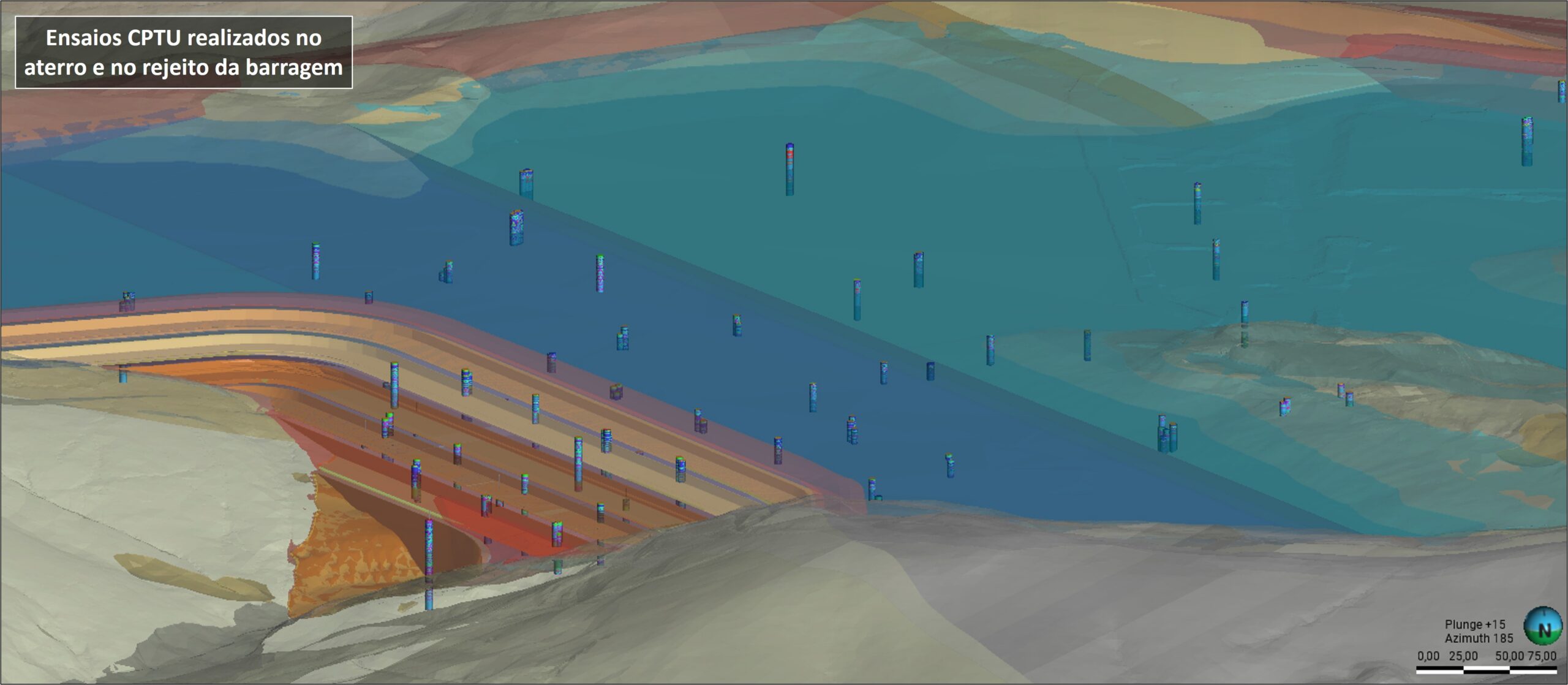
Image shows CPTU tests performed on the embankment and the dam tailings.
Source: Intertechne
Connected solutions to eliminate environment risk
Intertechne has almost 40 years of experience across a range of engineering work.
González Acevedo said it had been focusing more recently on the mining sector and dam decommissioning and stabilisation, safety, sustainability, and regulatory compliance.
In this project, software from Seequent, the Bentley subsurface company, had been adopted right at the start.
‘The main challenges faced involved the critical conditions of the dam, which restricted access for subsurface investigations, the high geotechnical complexity of the tailings, rigorous regulatory requirements, and the need for integration between 3D geological modeling, BIM, and advanced numerical analyses in 2D and 3D. Furthermore, the project demanded intense co-ordination among regulatory bodies, independent entities, and multidisciplinary teams.
‘Given the high degree of importance, the sensitivity of the project, and the need to reduce uncertainties associated with the behaviour of tailings and the structure’s foundation, the adoption of Bentley solutions was chosen due to their technical robustness and strong integration between tools.’
‘Native interoperability between the software allowed a continuous flow of data between disciplines, reducing information loss and ensuring greater consistency between geological and geotechnical models.’
‘Leapfrog was used to construct 3D models of the dam and its foundations, which were then imported into PLAXIS 3D to develop stress-strain models of the structure,’ he said.
‘The use of PLAXIS 2D and 3D allowed for drained, undrained, and coupled analyses of the construction sequence of the work, enabling the evaluation of a series of scenarios; with the use of the same constitutive model, making a more precise understanding of the structure’s behaviour possible and consequently the prediction of the performance of the stabilisation works.
The ability to automate analyses through Python scripting in PLAXIS was a key factor in the choice of software, González Acevedo said, alongside the availability of a constitutive model suited to the behaviour of the tailings, already implemented in PLAXIS.
Automating parts of the update workflow meant that as new investigation data arrived, the team spent less time rebuilding models and reconciling information between disciplines, increasing productivity and keeping the project on schedule.
‘The main success indicator of the project was the achievement of integrated, representative, and adequately calibrated geological-geotechnical models, reducing uncertainties and providing reliable technical support for decision-making in a project of high criticality and socio-environmental relevance.’
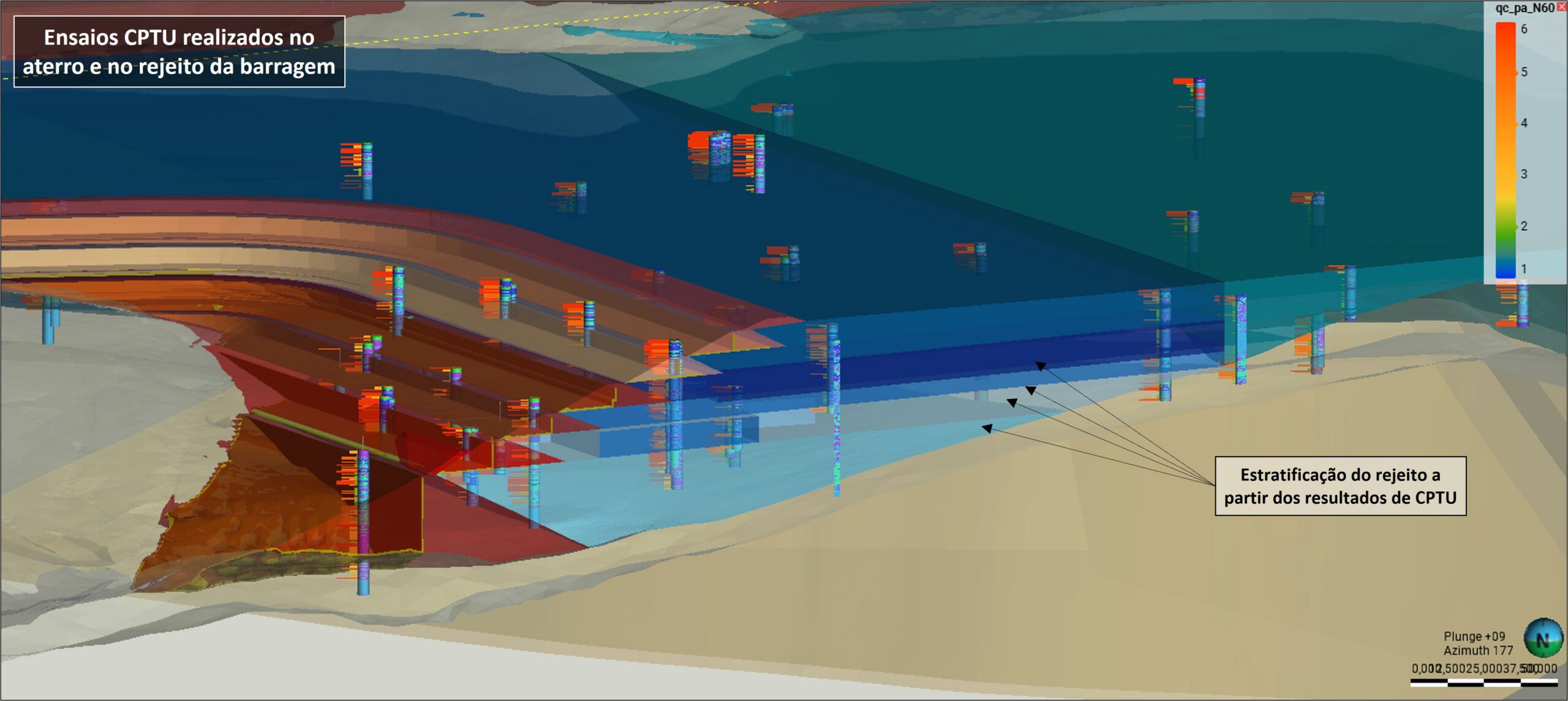
Image showing stratification of the tailings based on CPTU results.
Source: Intertechne
How Leapfrog and PLAXIS shaped the design
The use of Seequent software had optimised the design stage of Intertechne’s efforts to clean up the site and reintegrate it with the surrounding environment, González Acevedo said.
‘It eliminates a critical environmental liability, given that the structure was at a high emergency level which represents a high risk of rupture. From the conception of the decommissioning method at the conceptual stage, it was possible to perform 3D geological modelling of the geological conditions and the structure, using Leapfrog software, and with this to carry out stability and performance evaluations using PLAXIS 2D and 3D software, both for the current condition of the dam, and for the final condition with the decommissioning project implemented.’
‘In this way, solutions could be optimised, both in terms of geometries and the volume of materials, and consequently costs. As a final product, the complete elimination of an environmental liability and the integration of this solution with the environment, safely and without remaining risks, is expected.’
Leapfrog and PLAXIS achieved a ‘more accurate approximation of the conditions of the evaluated site, approximately 250,000 sqm of area in the reservoir region, dam, abutments, and downstream area’, he said.
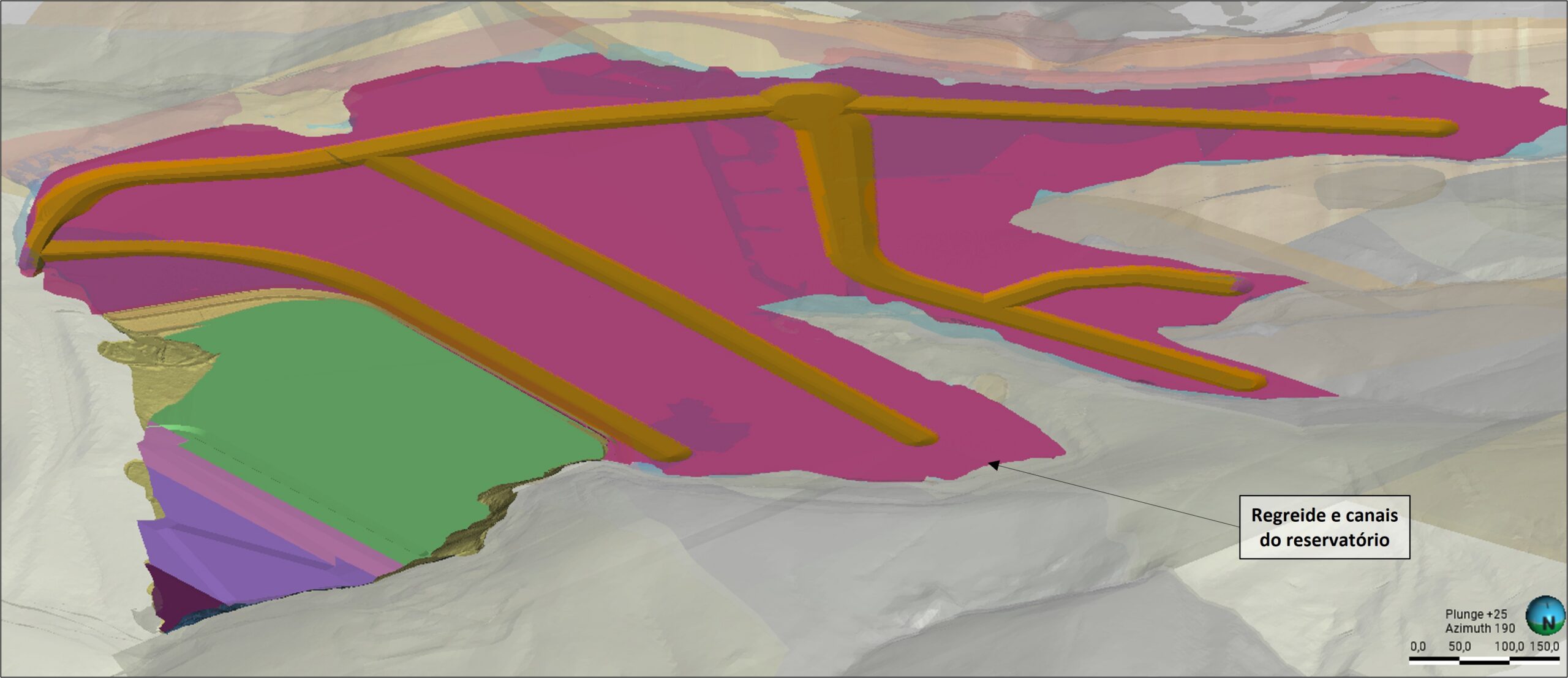
Image shoes the reservoir regrading and channels.
Source: Intertechne
Congonhas tailings dam remediation facts:
Location: Congonhas, in Minas Gerais state, Brazil;
Project cost: R$5 billion (US$962.3 million);
Completion date: December 31, 2035 (estimated)
* Intertechne Consultores S.A. was announced winner of the Subsurface Modeling and Analysis category at the Year in Infrastructure Awards 2026, hosted by Bentley Systems in Singapore.