



I attended Bentley’s Year in Infrastructure Awards in Singapore where I once again had the opportunity to learn plenty from all finalists, while also celebrating the individual category winners. What really struck me was how eager attendees were to learn from one another, and how generous they were in sharing their expertise with their peers.
That spirit matters, because the winning projects had a common thread – technology alone is insufficient: change management, data standards, clear ownership, and community engagement were critical themes across them all.
My congratulations to Intertechne Consultores S.A., the winner in the Subsurface Modeling and Analysis category, for its work supporting the safe decharacterisation of an upstream tailings dam in Brazil.
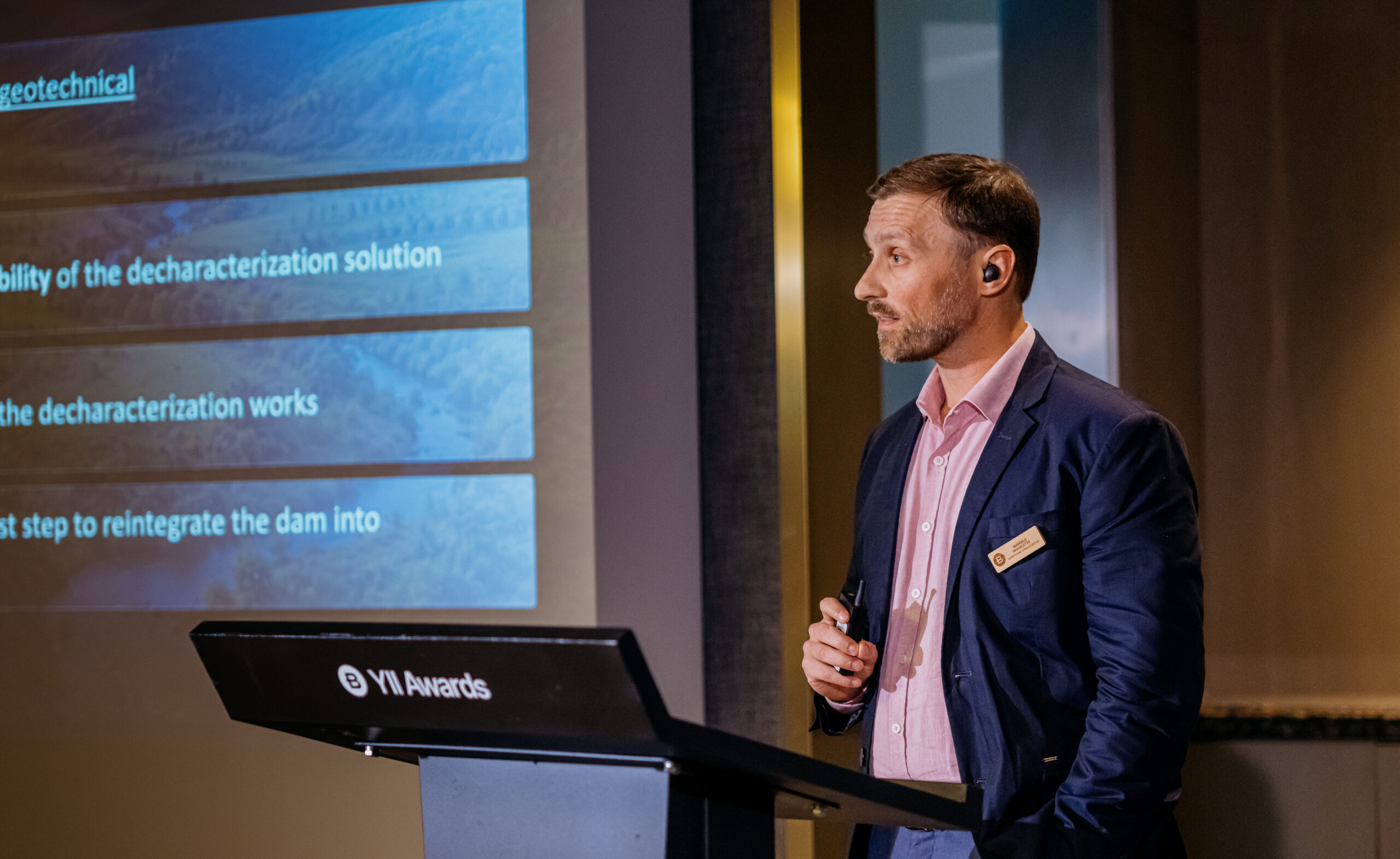
Marcello Miqueletto from Intertechne Consultores S.A during his finalist presentation. Intertechne won the Subsurface Modeling Category at the Year in Infrastructure Awards 2026.
Source: Bentley Systems
Behind those presentation moments sits a remarkable dataset. A total of 46 projects from 30 countries entered the Subsurface Modeling and Analysis category of Bentley Systems’ Year in Infrastructure 2026 Awards, spanning civil infrastructure, mining, energy, and environmental work. Those submissions provide a valuable snapshot of how geoprofessionals are actually working with the underground right now.
Two threads run through the entries: how teams are starting to use AI, and how much of their success rests on getting subsurface data into one governed, connected place first. Neither thread looks quite the way the hype cycle would predict.
Across those projects, AI was extending what experts could see and assess, while leaving interpretation and decision-making with people. Teams applied AI to predict mineralisation trends, extract data from legacy borehole logs, verify design consistency, and automate repetitive work, all grounded in trusted, connected, subsurface data. But people remained key to decision-making.

One of my favourite parts of Year in Infrastructure is the chance to hear directly from the people behind the projects.
Source: Bentley Systems
Beneath the hype: AI is arriving on geoscientists' terms
Roughly one in six entries used AI in some form. That number matters less than how the entrants describe it. Almost every AI submission makes the same point, unprompted and in its own words: AI enhanced their geological interpretation rather than replacing it.
The team behind a synthetic rare-earth exploration proof-of-concept, built on Brazilian geological data, put it plainly: AI ‘was not used to replace geological interpretation, but to enhance it by revealing spatial patterns that were difficult to define using manual or purely interpolation-based approaches’. A metro project team in Lisbon described AI as ‘a decision-support and verification tool, reinforcing engineering judgment rather than replacing it’. A university research team in India stressed that ‘final decision-making remained researcher-driven’.
In the subsurface, where uncertainty is the raw material, that stance is not caution. It is good science. The teams getting value from AI are the ones using it to make expert judgement faster, more transparent, and more defensible.
Four ways AI showed up in the entries
- Predictive geoscience. In a synthetic rare-earth exploration proof-of-concept based on Brazilian geological data, one entrant used Seequent Driver with Seequent Evo and Seequent Leapfrog Geo to map the spatial continuity of mineralisation from drilling assays. The AI-assisted trend revealed a mineralised extension beyond the initial drilling grid, demonstrating how the workflow could guide a future exploration campaign and focus drilling investment where the geology supports it.
- Unlocking legacy data. Engefoto, a Brazilian engineering and aerial survey firm, trained machine learning to read scanned drilling bulletins and extract borehole names, co-ordinates, penetration resistance values, stratigraphy, and water levels automatically, feeding a live 3D model in Seequent Leapfrog Works. Decades of ground investigation data sit locked in PDFs; AI is opening them up.
- Supporting human review. On the Lisbon metro extension, AI cross-checked numerical consistency across a large, continuously changing design-and-build document set, and cross-referenced drawings against settlement predictions. It provided a second pair of eyes, at machine speed.
- Accelerating team production. Several teams used generative AI to write automation code and analytics dashboards, clearing repetitive work so engineers and geologists could spend their time on interpretation and decisions.
None of it works without trusted data
Seven entries built on Seequent OpenGround as a single source of truth for ground investigation data, and several describe the same journey: moving from gINT, spreadsheets, and PDF boring logs into one governed, cloud-based environment. On a former manufactured gas plant remediation in Illinois, Burns & McDonnell centralised more than 360 investigation locations and 130,000 rows of data, with the team reporting the software ‘handled it with ease’ compared with workbook and PDF workflows. On the Springbank Off-stream Reservoir flood mitigation project in Canada, Stantec connected three phases of investigation and hundreds of construction-phase tests into a single digital ground model that informed decisions right through construction.
One entry took the platform somewhere new entirely. Macquarie Geotechnical in Australia rebuilt bored-pile inspection on OpenGround, turning a 30-to-60-minute manual check per pile into an algorithmic digital workflow across 13 sites and more than 1200 possible footing outcomes. That innovation saved more than 1500 hours and $1 million, and also prevented 400 tonnes of carbon emissions by eliminating unnecessary concrete usage.
Trustworthy AI needs trustworthy data underneath it. Governed geological data management is not the boring prerequisite to the AI story. It is the AI story.
Turning subsurface understanding into outcomes
- An 88% reduction in remediation excavation volume on a Brazilian environmental project, after 3D modelling showed only 7300 of 63,000 cubic metres of waste was genuinely reactive.
- Geological model rebuild cycles cut from as long as a year to around two months at the Buritica gold mine in Colombia, on a database of more than 2 million records.
- Ten production wells and roughly 23 megawatts of clean geothermal power at Ethiopia’s Aluto geothermal field, with well targeting guided by a 3D conceptual model in Leapfrog.
- An estimated 87% reduction in computation time on a Taiwanese metro excavation study, by coupling Seequent PLAXIS 2D and 3D analyses rather than defaulting to conservative assumptions.
Where this goes next
The geoprofessionals behind these 46 entries are the ones forging the change; our job is to keep building the software that helps them go further. If this year’s category is any guide, the next few years of AI in geoscience will be defined not by machines replacing judgement, but by trusted data and AI-assisted workflows giving good judgement further reach.
Congratulations to every team that entered, and to our finalists and winner. The underground is in good hands.
Related content
* Year in Infrastructure 2026: Subsurface and Modeling Analysis winner announced
* From hype to impact: Seequent’s perspective on MCP, vibe coding and the future of AI in geoscience
* Powering trustworthy AI in mining with Seequent Evo
* Transforming geoscience with AI
* The billion-dollar gamble beneath every data centre