



Better decisions require trusted data, clear lineage, and an understanding of how insights were generated.
The challenge with geology is that it is fundamentally an uncertain business. The underground can’t be seen, the data we have is sometimes interpretive (like geophysical data) on sparse samples of data (like drillholes) but does get progressively more reliable as mining moves into production. At each phase in the life cycle from exploration to production assumptions are taken, disproven, and models updated. But by taking this information – and the learnings from it – in aggregate we can progressively reduce uncertainty and make better decisions.
The more complete, connected, and contextualised the data, the more accurate and trustworthy the decisions become: whether they are made by a person or with the support of AI.
A complete dataset
Critical decisions (like those involving subsurface data for resource estimation or civil engineering) require a complete view of the data.
The trouble with subsurface is it is often sparse, fragmented, and in siloed systems. Before investing in (or relying on) AI it is important that data be brought to a unified layer.
Mining data is often fragmented across teams, applications, and formats. A typical mining company usually has geological models in tools like Leapfrog Geo, drillhole data in databases including MX Deposit, geophysics data in Oasis montaj, geotechnical analysis in PLAXIS or GeoStudio 2D/3D, planning data in third-party mine planning tools like Deswik, and countless spreadsheets. Different teams own different datasets, use different formats, and often work in separate systems.
Bringing all this data together is important because the answers mining companies need rarely exist in a single dataset.
A geologist may identify a promising orebody in Leapfrog Geo, but determining whether it can be mined profitably also requires geotechnical constraints from PLAXIS or GeoStudio 2D/3D, geophysical data from Oasis montaj, operational planning information, and historical drilling results. When data remains siloed, teams make decisions with only part of the picture.
- Make better decisions by viewing the complete subsurface picture rather than isolated datasets.
- Improve collaboration because geologists, geotechnical engineers, hydrogeologists, and mine planners can work from the same source of truth.
- Reduce risk by preserving context, lineage, and relationships between datasets, making it easier to understand whether information is accurate and trustworthy.
- Increase productivity by eliminating time spent searching for, reconciling, and validating information across multiple systems.
All of this also enables AI because AI can only reason over the data it can access. A unified data foundation allows AI to connect information across workflows instead of analysing isolated files or applications.
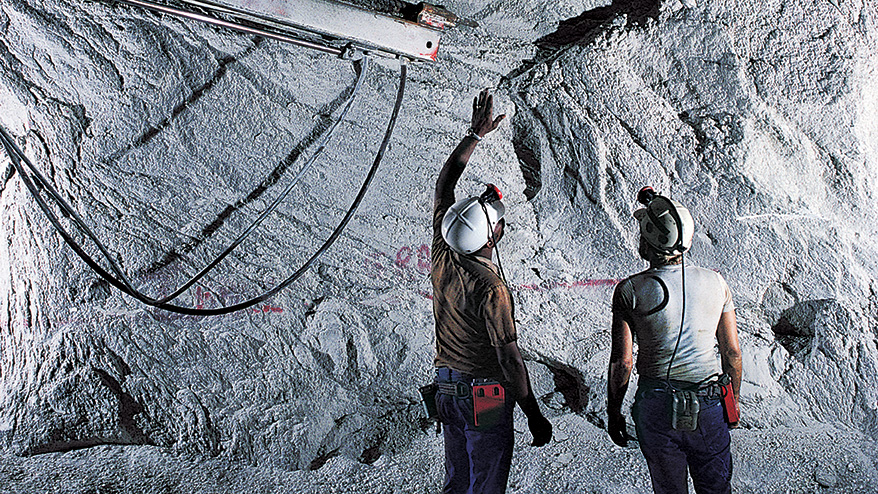
Geology is an uncertain business. Data is sparse, interpretive, and only grows more reliable as mining moves into production. The more complete, connected, and contextualised that data becomes, the more trustworthy the decisions, whether made by a person or with the support of AI.
Source: Getty
Related content:
* From hype to impact: Seequent’s perspective on MCP, vibe coding and the future of AI in geoscience
* Transforming geoscience with AI
* The billion-dollar gamble beneath every data centre
* Watch: Driver is about the ‘next generation of intelligent geology solutions’
* Openness will shape the future of geoscience
Contextualised data builds trust
When making a decision we need to consider the source and the context.
In mining, data without context can be misleading, and misleading data can lead to costly decisions. A drillhole assay, geological model, geotechnical measurement, or resource estimate only becomes useful when you understand where it came from, how it was collected, what assumptions were applied, who modified it, and how it relates to other datasets.
For example, knowing that a rock sample contains a certain grade of copper is useful. Knowing where the sample was taken, how it was assayed, when it was collected, which geological domain it belongs to, and whether the data has been validated provides the context needed to trust and act on that information. Without that context, engineers and geologists risk making decisions based on incomplete or incorrect interpretations.
Powerful compute unlocks AI
Traditional geology and geoscience software has required users to bring data to desktop applications, reflecting the practical realities of remote operating environments and the need to protect highly proprietary information. Advances in security and internet connectivity are now reducing these constraints. At the same time, the growing need for connected workflows, collaboration, and AI is accelerating cloud adoption, as the value of data increasingly depends on bringing it together in a secure, trusted, and accessible environment.
Bringing computation to the data is important because moving large mining datasets is often slow, expensive, and risky.
Geological models, drillhole databases, geophysics, geotechnical analysis, imagery, and historical data can be extremely large. Traditionally, data is extracted from multiple systems, copied to local machines, processed, and then moved again, creating delays, version control issues, and additional security risks.
- Performance: Large-scale calculations and analyses can leverage cloud compute resources, enabling faster processing of larger datasets.
- Data integrity: The data remains in a controlled environment, reducing duplication, version conflicts, and the risk of working on outdated information.
- Enabling AI: AI agents can access trusted datasets and approved geoscience algorithms directly, without first collecting and reconciling data from numerous disconnected sources.
How Seequent Evo supports AI-ready data
Evo provides the trusted data and compute foundation needed to make AI useful for mining. It brings geoscience data from Seequent and third-party applications into secure, collaborative workspaces, reducing silos and helping teams work from current, shared information. By preserving the structure, relationships, lineage, and permissions around that data, Evo gives people and AI the context required to interpret it confidently. Its open APIs connect workflows and support custom applications, and it can ingest data from any source that offers an API or CSV export, as well as offering connectors to common mine planning software like Deswik. Cloud compute brings scalable processing and machine learning directly to the data—reducing unnecessary movement, duplication, version conflicts, and security risk.
This unlocks AI grounded in trusted geoscience data and approved domain workflows.
Evo also becomes the foundation for future learning. By preserving not only data, but the interpretations, assumptions, decisions, changes, and outcomes connected to it, Evo helps organisations retain knowledge that would otherwise be lost across projects, hand-offs, or staff changes. Over time, teams and AI can learn from what worked, what did not, and why – allowing geological understanding to accumulate rather than be repeatedly reconstructed. This turns local expertise into an enterprise capability and helps every new decision benefit from the organisation’s past experience.