


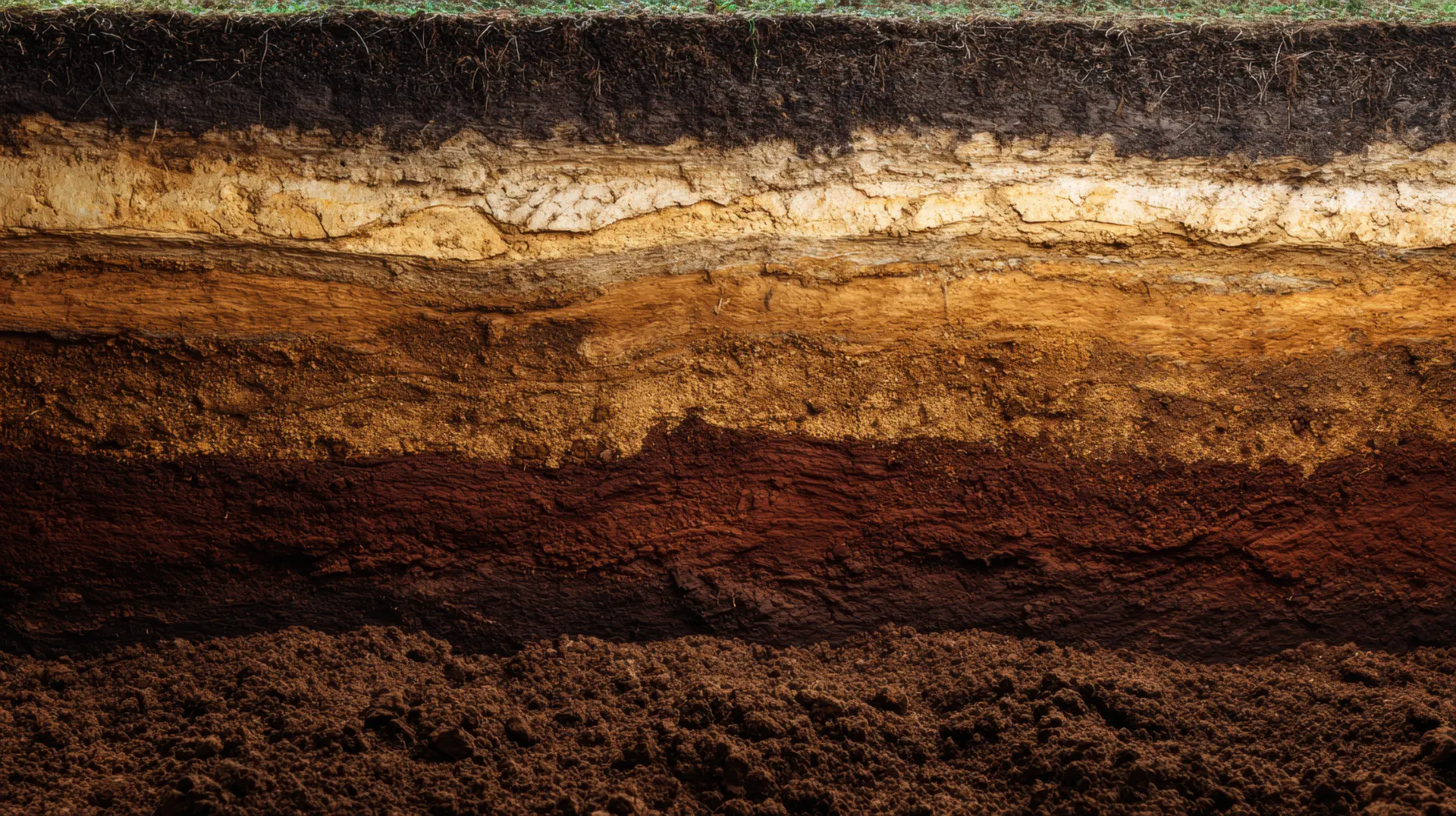
All 8.3 billion of us inhabit a small, rocky, watery sphere tied to the Sun and dependent on it. Understanding how we can protect ourselves from Earth’s hazards and use its resources sustainably and most effectively is crucial for our future.
What is geoscience?
Geoscience is the study of Earth. As a geologist, I like to think of geology as the anchor, encompassing the study of rocks and minerals, including volcanoes and, through paleontology, ancient organisms and long-ago environments.
- Geophysics, looking into the Earth’s interior using seismic waves, magnetic fields, and gravity anomalies.
- Geochemistry, studying how the elements make up rocks and minerals and help decipher earth’s processes.
- Hydrogeology and environmental science includes groundwater dynamics, water security, soil health, and environmental remediation.
- Atmospheric and oceanic sciences including meteorology, climatology, and oceanography track the fluids enveloping earth to model short- and long-term weather, climate patterns, and marine systems.
- Planetary science and astronomy, which are traditionally considered earth sciences, give us crucial context for Earth’s formation and processes, as well as how our planet fits into the broader solar system and cosmos.
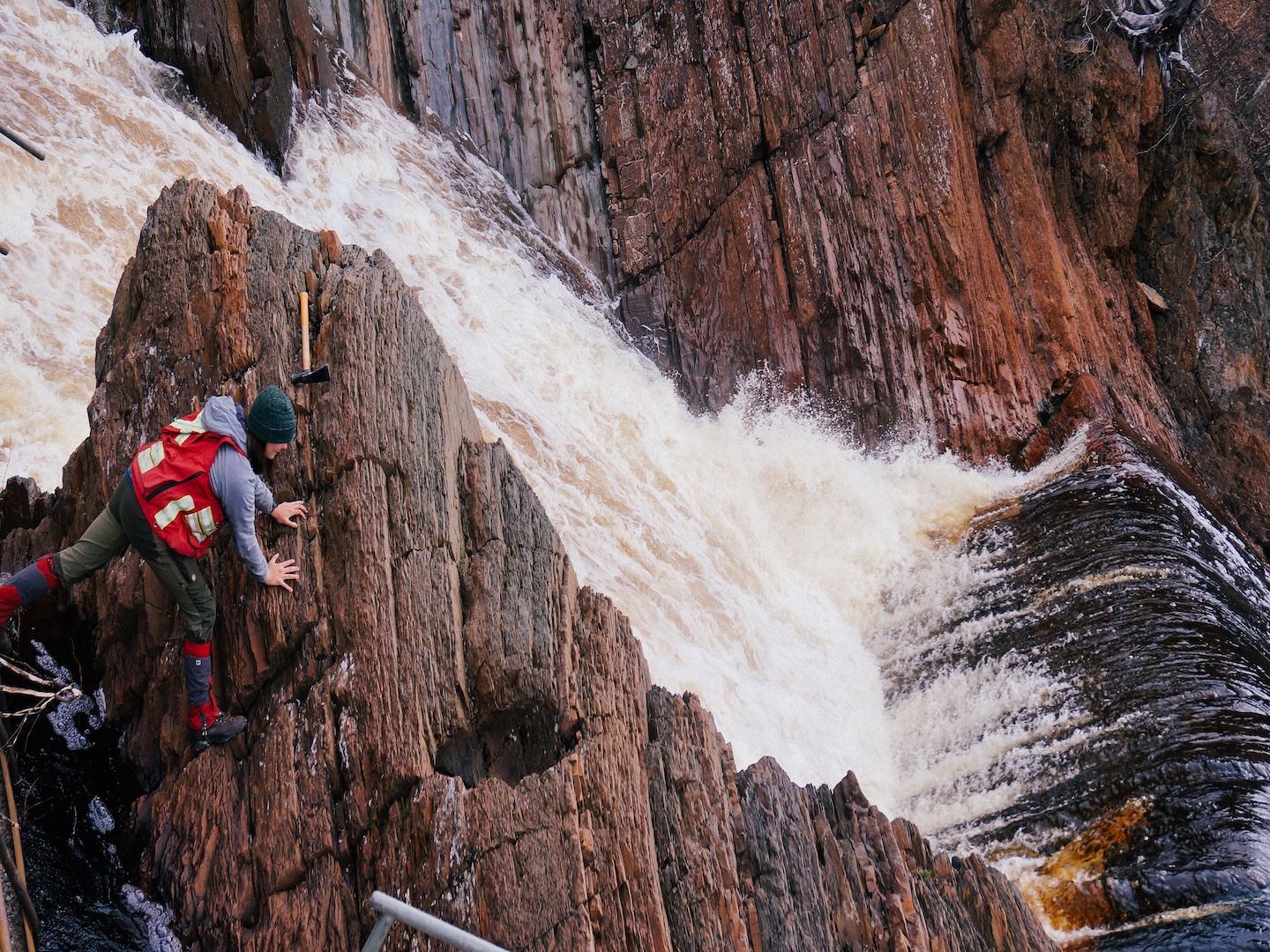
Deciphering an outcrop next to a sideways waterfall. Hands-on field mapping forces you to look at the situation from multiple angles.
Humans are naturally curious about our home planet. The earliest geoscientific observations date back to ancient times, and many of us today would admit to having had rock collections as a child (or currently having one as an adult). Work in all these fields is carried out not just to satisfy our scientific curiosity but to ensure natural resources can be harnessed to support a sustainable society.
Are ‘geoscience’ and ‘earth sciences’ the same?
Generally, yes, they are both terms for describing the interdisciplinary study of the Earth.
What does a geoscientist do?
A single job description would hardly sum it up, and for many of us, the variety is part of the appeal.
On any given day in my work as a geologist, I might be in the field conducting geological mapping, describing observations, and taking samples. The next day I might be in the core shack describing drill core and recording structural measurements, or perhaps at the rig ensuring it’s correctly lined up for our next drillhole. In the office, I’d integrate recently collected data with historical data to digitally visualise the project geology, ultimately building maps, 3D models, and cross sections which I could then use for presenting results in reports or presentations.
Depending on specialist field, this may look a bit different, but typically geoscientists have a field component for data collection and observation, and then office work, which can include tasks such as three-dimensional modelling, data analysis, and report writing. Artificial intelligence is increasingly being used for number-crunching and modelling, allowing geoscientists to focus on the cognitive and interpretive components of the geoscience: critical thinking, geological interpretation, and testing hypotheses.
Some of the more unusual tasks in earth science may include ‘sniffing’ volcanoes with remote sensors to measure emissions and forecast; drilling deep ice cores to reconstruct climate conditions from hundreds of thousands of years ago; and helping forensic investigations by analysing soil or rock samples from a crime scene.
Engineering geology and geotechnical engineering are applied fields which focus on construction and infrastructure projects and investigate soil, rock, and groundwater to ensure public safety.
Is there a shortage of geologists or geoscientists?
Yes – which makes it a great time to become one.
There is huge demand for expertise as the world builds climate resilience and advances the global energy transition, hinging on the discovery and development of critical mineral resources, scaling up geothermal energy, and engineering carbon capture and storage projects. The impacts of more frequent severe weather make work in geotechnical engineering and groundwater management even more essential.
Seequent Chief Executive Graham Grant, has spoken several times about a talent crisis in the earth sciences, caused by the retirement of many experienced specialists and falling university enrolments.
‘If the data is true … years of subsurface knowledge will walk out the door,’ he said in February.
A key solution to the problem will be geoscientists keen to focus on collaboration and adopting new technologies, he said.
According to the American Geosciences Institute, there could be a shortage of around 130,000 geoscientists in the United States alone by 2030.
Seequent is doing its bit to inspire geoscience students around the world with its free-to-use Visible Geology application, allowing them to build, manipulate, and explore rock layers in 3D. More than 200,000 students and educators from 117 countries now use it.

Learning to think in 3D is a massive hurdle. Because wrapping your brain around spatial relationships can be challenging, Visible Geology lets the next generation of earth scientists build, fold, and fault rock layers interactively in 3D.
How do I become a geologist or geoscientist?
A university qualification in geology or the relevant geoscience is essential, with a thorough background needed in mathematics and relevant science, such as physics, chemistry, or biology. Software and AI skills are also hugely useful.
Most Bachelor of Science courses in geology include fieldwork and significant lab work. In some regions and fields of practice, a postgraduate degree which specialises in a particular geoscience is often the industry standard, and a good way to ensure a role as a scientist instead of a technician.
However, don’t underestimate the power of perfecting your chosen craft through field time and literally seeing as many rocks as possible. The value of applying the knowledge is so much more important that seeing a photo in a textbook.
Knowledge isn’t the only skill you’ll need if you want a successful geoscience career. Being easy to get along with in a camp setting and the willingness to try all sorts of different things will take you super far in this career. This is definitely something you learn outside of the classroom.
What might my geoscientist or geologist career path look like?
The skills learnt in geoscience provide a flexible career path, one in which it is easy to transfer between roles and organisations as you gain more experience. It is likely fieldwork will play a major part in the first 10 years as a geoscientist. As practical knowledge grows, there are multiple paths you can take at the senior level: you can move into management, making key decisions and setting strategic directions for organisations, or continue to refine your expertise as a senior geoscientist in specialised fields, such as geostatistics or structural geology.
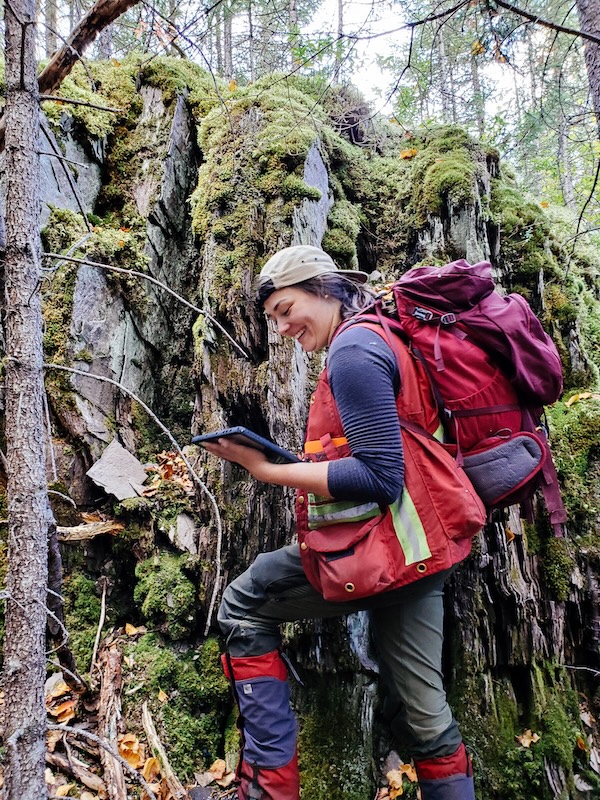
A moment of joy: finding an outcrop to map in the middle of a bog. I only had to survive a super dense forest and several boggy surprise holes trying to swallow my leg.
Or you can make some rewarding pivots. When I first picked up a rock hammer, I had no idea it would eventually lead me into geological modelling tech, and strategic product marketing. Starting out in university labs and remote exploration camps, I certainly didn’t expect those early field skills to translate into spatial data and software.
Geoscience skills are remarkably versatile – you aren’t locked into one path. Part of this versatility comes from the inherently interdisciplinary nature of our science, as well as the way it trains you to solve complex and incomplete puzzles. It also stems from humanity’s deep dependence on the Earth. As societal needs evolve, so does the work required to understand, protect, and resource our planet.