


Mining is an inherently uncertain business. Information about the underground is sparse and increasingly more expensive to collect. In the not so distant past, companies drilled extensive grids to create tangible insight. But with rising operational costs and deeper targets, a new mantra governs business decisions: quality over quantity. The focus lies on process optimisation and technical innovation for maximum output. Exploration, whether in greenfields targeting or near mine expansion, is under pressure from investment constraints and relies on multiple investigative methods to fill the literal gaps.
Geophysical surveying, whether magnetic, gravity or electromagnetic, has improved drastically in terms of their sensitivity and field applicability. When these non-invasive techniques are coupled with drilling and clever data analytics in solutions such as Oasis montaj and Leapfrog, the resulting insights reduce uncertainty and effectively reduce the footprint of mining.
As commodity prices rise, mining experiences a unique paradox. While mining companies are growing rapidly, the costs of new resource discovery are too high and time to project fruition is too long. Near-surface ore bodies have effectively been picked clean or the deposit geometries are too complex. Today, the focus lies on brownfields projects (which tend to be more economically viable), ideally with an established operational infrastructure, and a sustainable cut-off grade. The only way forward is to push deeper. But with greater depth, uncertainty rises. Established investigative methods start to fail and so every decision carries enormous cost and risk. Fortunately, seismic interpretation offers a powerful way to close that knowledge gap.
Long established in the energy sector, seismic is the only non-invasive exploratory method that can produce a high-resolution image of the subsurface at depth. It has the potential to help geologists and engineers to accurately map geological architecture, delineate ore body potential, and define structural controls.
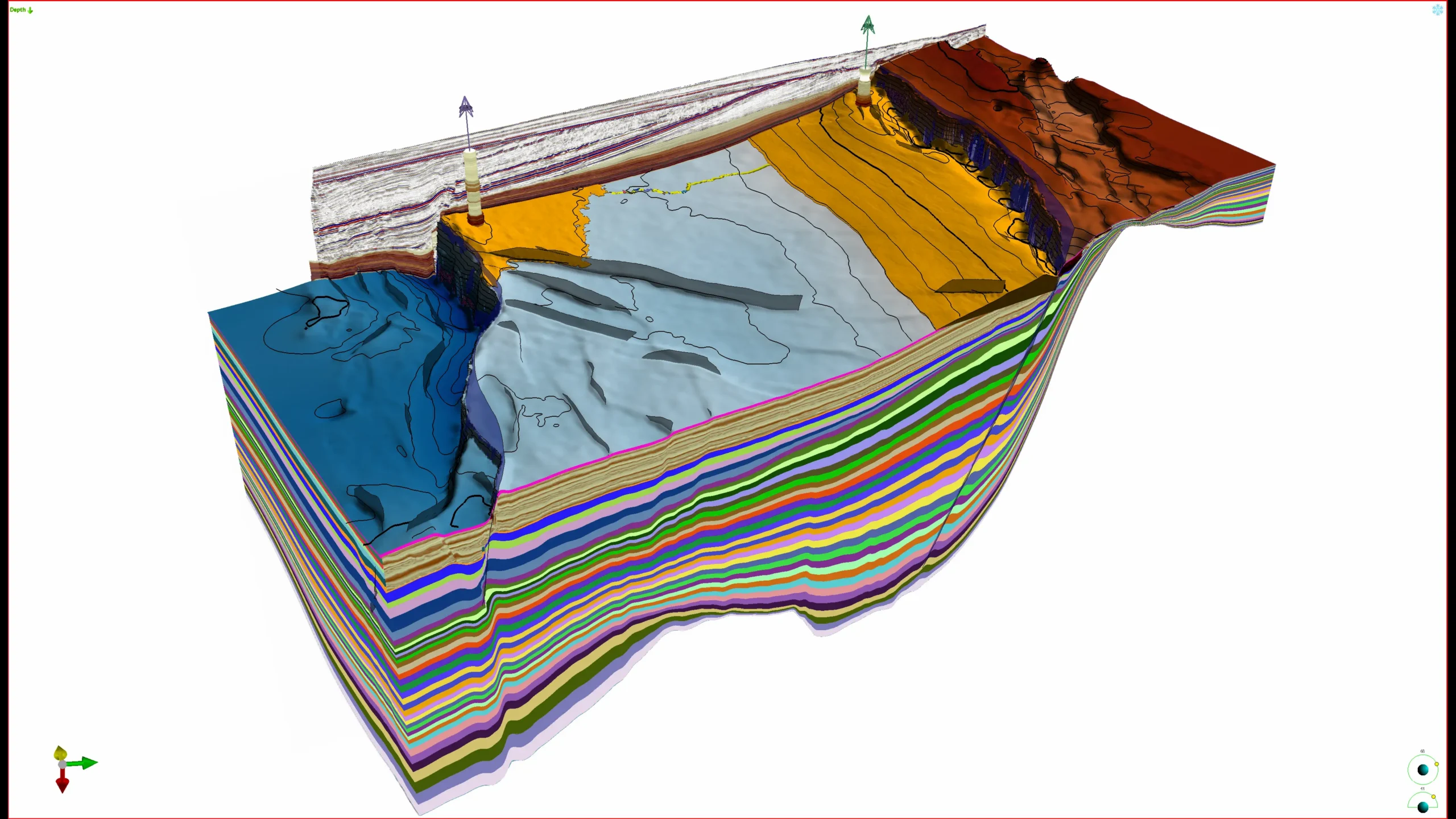
A 3D view of seismic interpretation utilizing relative geological time in PaleoScan
Why seismic matters now
Mining has historically used less seismic than oil and gas. Acquisition and interpretation were expensive, and complex hard-rock environments presented technical challenges.
That is changing. New high sensitivity sensors and acquisition approaches reduce surveying logistics and overall costs, while advances in AI-assisted interpretation are making large seismic datasets faster to analyse. In effect, seismic has become a real opportunity in mining.
Research and industry representatives highlight the growing role of seismic in targeting and mine planning. The opportunity is not to replace established geological and geophysical investigative methods, but to enhance them to collectively focus deep directional drilling and safe mine development and expansion.
Seismic subsurface imaging can help teams:
- • refine geological interpretations
- • target drilling more precisely
- • identify new targets at depth or potential for mine expansion
- • improve inputs to mine design and geotechnical assessment
For mining companies under pressure to discover, define and develop resources more efficiently and safely, this added context reduces uncertainty and inherent risk through more confident decisions.
Why Seequent is acquiring Eliis
Seequent’s purpose is to help organisations understand the underground. Our mining solutions already support geophysical analysis, 3D geological and geotechnical modelling and data management with industry-leading solutions such as Leapfrog Geo, Oasis montaj, GeoStudio, PLAXIS and Seequent Evo.
Eliis adds an important layer: advanced seismic interpretation.
Founded in 2007, Eliis develops PaleoScan, a 2D and 3D seismic interpretation platform that combines patented Relative Geological Time technology with AI-assisted workflows. It enables geoscientists to transform seismic volumes into a coherent geological-time framework, interpret more of the seismic cube and extract geological insight faster.
The acquisition also brings a globally recognised team of seismic experts into the fold. Their specialist knowledge will help Seequent make seismic interpretation an integrated part of geological and geotechnical investigation in mining.
A more complete view of the subsurface
PaleoScan, Leapfrog Geo, Oasis montaj, GeoStudio, PLAXIS, and Evo are complementary.
PaleoScan interprets seismic data and creates outputs such as horizons, faults and geological-time framework. Leapfrog Geo turns geological observations and interpretations into dynamic 3D models. Oasis montaj supports the processing, analysis and integration of other geophysical datasets (like gravity and magnetics) while GeoStudio and PLAXIS address the geotechnical safety of mine infrastructure. Evo provides a trusted environment for connecting subsurface data, context, lineage and computation.
These capabilities, in combination with seismic interpretation, have the potential to inform geological and geotechnical decision-making more directly. They also create a stronger foundation for AI workflows that can reason across all disciplines rather than treating each dataset in isolation.
We are being deliberate about this opportunity. Today, these solutions can exchange data through point connections. They are not yet a fully integrated end-to-end workflow. Future connections will be shaped by customer value, technical validation and openness. One aspect is certain, with an evolving connected solution, the ROI of the initial seismic survey will improve over time.
What this means for mining customers
For Seequent customers, this acquisition expands the range of subsurface problems we can help address. It strengthens our geophysics capability while preserving the specialist focus that has made Eliis successful.
Our goal is to help mining teams extract more geological understanding from seismic data, carry that understanding into their models and make better-informed decisions from exploration through mine planning.
Seismic will not be the answer everywhere. Its value depends on geology, survey design, data quality, and the decision being made. But as exploration moves deeper and complexity increases, it can become a critical part of the modern mining toolkit.
By bringing Eliis into Seequent, we are adding the technology and expertise required to help customers explore this opportunity—with more context, greater confidence, and a clearer view of the potential at depth.