


May 24, 2026
By Fiona Jeffreys
Utah FORGE represents one of the most significant geothermal research investments globally, with a clear mandate: learn quickly, share openly, and reduce risk for industry. Seequent Central supports this work by enabling Utah FORGE to make complex subsurface interpretations openly accessible, interactive, and testable by the global research community.
Utah FORGE (Frontier Observatory for Research in Geothermal Energy) is a U.S. Department of Energy (DoE) funded national field laboratory, aiming to accelerate breakthroughs in Enhanced Geothermal Systems (EGS) technologies.
Located near Milford, Utah, the FORGE site serves as a testbed for developing new tools, techniques, and workflows to expand EGS potential and boost its global adoption.
While conventional geothermal energy relies on drawing heat from naturally permeable underground reservoirs, EGS takes a different approach – engineering permeability into hot, dry rock. If proven at scale, the technology could provide clean, reliable baseload energy beyond current geological constraints.
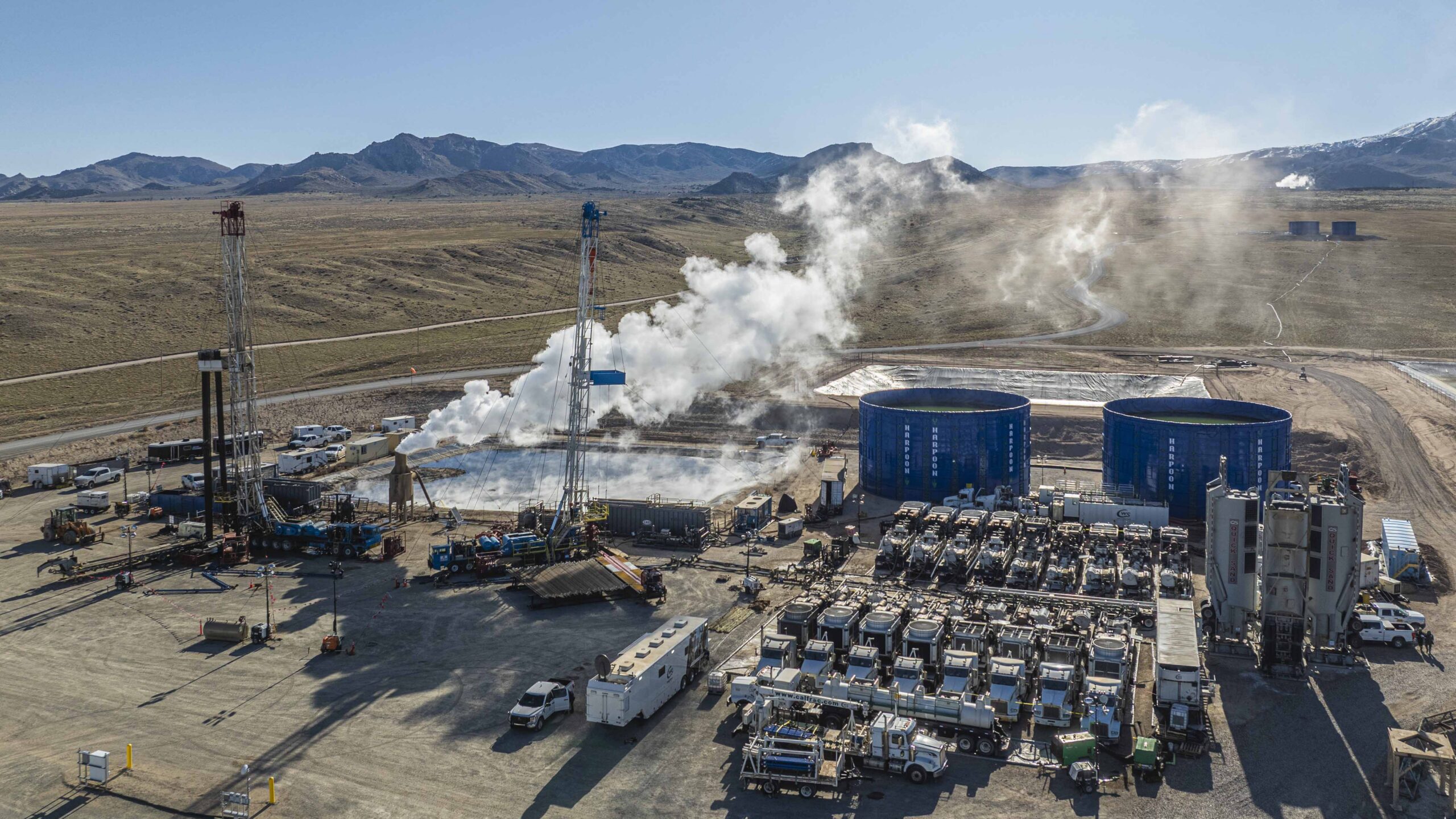
Since 2018, Utah FORGE has received US$300 million in DoE funding to study underground natural fractures, fluid geochemistry, and long-term system performance to support sustainable geothermal development.
Source: Utah FORGE
Dr Clay Jones: Grounding models in real rock
Since 2018, Utah FORGE has received US$300 million in DoE funding to study underground natural fractures, fluid geochemistry, and long-term system performance to support sustainable geothermal development.
At the heart of the project’s subsurface work is Dr Clay Jones, Chief Geologist and Research Scientist at the University of Utah, Energy & Geoscience Institute (EGI). Having worked on Utah FORGE since its 2014 inception, he brings long‑term continuity to a project that has evolved through multiple drilling, stimulation, and testing phases.
‘At Milford, we think we’re sitting on a pluton (a cooled magma chamber) 6 to 8 kilometres below the surface, with a volume of about 300 to 400 cubic kilometres. That’s our heat source down there. That’s the hot pan,’ Dr Jones said.
‘Our geological modelling for the project isn’t about finding one answer – it’s about testing which interpretations hold up against the physical evidence with my role grounding these interpretations in real rock,’ he said.
His expertise in mineralogy, alteration, and the analysis of cuttings and core, allows him to validate geophysical and geomechanical observations against what is actually present in the geology.
‘There are a lot of mysteries, even geothermal wells drilled only a few hundred feet apart can behave very differently underground and trying to find the geologic answers to those mysteries is where we fit in.’
Dr Clay Jones’ work focuses on understanding how fracture systems form, connect, and evolve.
Source: Utah FORGE
Natural fractures: The geochemical twists and turns
Since the early stages of the Utah FORGE project, field experience has reshaped many initial assumptions. One of the most important lessons is the role of natural fractures.
Alongside the EGI team, Dr Jones’ work focuses on understanding how fracture systems form, connect, and evolve – critical questions for any engineered geothermal system.
‘To most efficiently mine underground heat, you want a fracture system that resembles radiator fins that are equally spaced and with equal flow between them. However, natural fractures don’t behave predictably. We see fracture zones take unexpected turns and wind up in places where they shouldn’t be,’ he said.
That’s because rather than behaving as a uniform rock mass, fracture networks naturally bend, intersect, and converge, sometimes creating ‘short circuits’ that can extract heat too quickly. Understanding and managing these dynamics is key to this pioneering project and vital for the long-term success of any enhanced geothermal system.
Geochemistry has also emerged as a crucial factor. Rapid, unforeseen changes in fluid chemistry highlighted the risks associated with mineral precipitation and scaling.
‘These kinds of findings have shifted our operational priorities toward protecting fractures, wells, and surface infrastructure, and reinforced the need to treat geothermal systems as dynamic and evolving rather than static resources,’ he said.
Technical outcomes: A learning-by-doing philosophy
Seequent, the Bentley subsurface company, has partnered with Utah FORGE since 2018. Its Leapfrog Energy software integrates geological, geophysical, and well data from the Milford site for core modelling.
‘New data rarely closes out any questions for us,’ Dr Jones said. ‘More often, it highlights uncertainty and directs future investigation. If I’m looking for a major fracture zone, which data sets would help me find it? Relying on just one data set isn’t enough – I need validation.’
In keeping with FORGE’s learning-by-doing philosophy, Dr Jones and the team look to their 3D geological models to uncover connections between datasets and visualise areas where interpretations are well-supported or more evidence is needed.
‘For me, the biggest benefit of creating a geological model in Leapfrog Energy is its three-dimensional capability. I can spin it around, visualise it in my head and overlay many different complex data sets to see how they interact with each other,’ he said.
‘By integrating well logs, perforations, frac hit data, microseismic information, and other geological analyses, I can more efficiently spot unique features within a target area or zone. Ultimately, I want to make sure I can connect those findings back to my reality, which is the actual rocks. Incorporating new data inside the modelling environment helps the team understand the variations in the rocks beyond the wells.’
Seequent Central: Data transparency, team collaboration
Seequent Central underpins both internal collaboration and external engagement across the project. Internally, it offers a shared, auditable space for teams to view, update, track, and manage subsurface models as they evolve.
Externally, Central enables FORGE to publish interactive models directly through its website, lowering barriers for researchers, industry partners, and the public to explore complex subsurface information without specialist software. This openness reinforces confidence in the data and supports FORGE’s role as a national learning project.
‘Our goal is to accelerate EGS uptake, and to get this up and running we need to try new technologies, entice others to give it a go, share our learnings, successful or otherwise, and to be as transparent as possible,’ said Dr Jones.
‘Seequent Central provides an inside look at our data sets, showing how everything connects. It helps me present information more effectively by organising complex details and making it interactive – people can click, rotate, and use their imagination to explore all the relationships.’
Industry impact and future direction
The workflows and insights developed at Utah FORGE are intended to be reproducible. Dr Jones notes that much of the knowledge gained – including fracture behavior, modelling techniques, and data sharing protocols – has direct applicability to commercial geothermal ventures.
Industry replication is already in progress, fueled by increased interest and new DoE-supported initiatives. For example, Fervo Energy’s Cape Station, located next to the Utah FORGE site, builds on FORGE’s open data and learnings to advance the first large-scale commercial EGS development and support global sustainability efforts.
Looking ahead, one of the most critical questions is longevity: how long an engineered system can sustainably extract heat.
‘This heat is renewable and can be replenished, but not as quickly as we are extracting it. We’re currently pulling it out faster than it’s radiating from the centre of the Earth,’ said Dr Jones.
‘If you’re investing tens or even hundreds of millions of dollars to construct one of these systems, you’ll likely want to know how long it will last before you need to drill additional wells or relocate to another site.’
Upcoming circulation tests and potential future drilling of a third deviation well will provide essential data to explore this uncertainty. By continuing to ensure that results remain open and easy to access, Utah FORGE is helping lay the groundwork for geothermal systems that can be both viable and scalable.