


By Maria Nicolaidis, Segment Marketing Manager
The mining industry stands at a crossroads. Faced with accelerating demand for critical minerals, increasing operational scrutiny, and an unprecedented pace of technological change, mining companies are redefining how they explore, extract, and engage with the world.
At Bentley’s Year in Infrastructure 2025 in Amsterdam Angela Harvey, Seequent’s Chief Customer Officer, sat down with a distinguished panel of industry experts to explore how geopolitics, technology innovation, data, and new mindsets will shape a more resilient and responsible industry.
- Mark Campodonic, Corporate Consultant, Resource Geology, SRK Consulting (UK)
- Liv Carroll, Managing Director, Accenture, EMEA Mining Lead and Global Natural Resources Lead for Data & AI
- Chris Jackson, Technical Director Subsurface, WSP
- Dr David Skilling, Founding Director, Landfall Strategy Group
Mining at the centre of global transformation
‘You can’t understand the global economy today without understanding mining,’ said Dr. David Skilling. ‘The scale and speed of what we are seeing in the mining sector is almost unprecedented. The global race for critical minerals—from lithium and nickel to rare-earth elements—is reshaping geopolitics and economics alike.’ In just a few short years, critical minerals have become a central focus in boardrooms and government policies, demonstrating that mining’s influence extends far beyond the pit or port.
Seequent’s Visible Geology aims to demonstrate to both students and educators not only the importance but the reward of pursuing a career in geoscience
Skilling emphasised that mining’s role in the green transition is mission critical—not only for energy systems but also for national resilience. While traditional mining companies often face constraints due to shareholder expectations and quarterly reporting, emerging markets are investing strategically for the long term. ‘Governments in places like Saudi Arabia and China have greater degrees of freedom to allocate capital,’ he noted. ‘We may see Western governments getting more involved to remain competitive.’
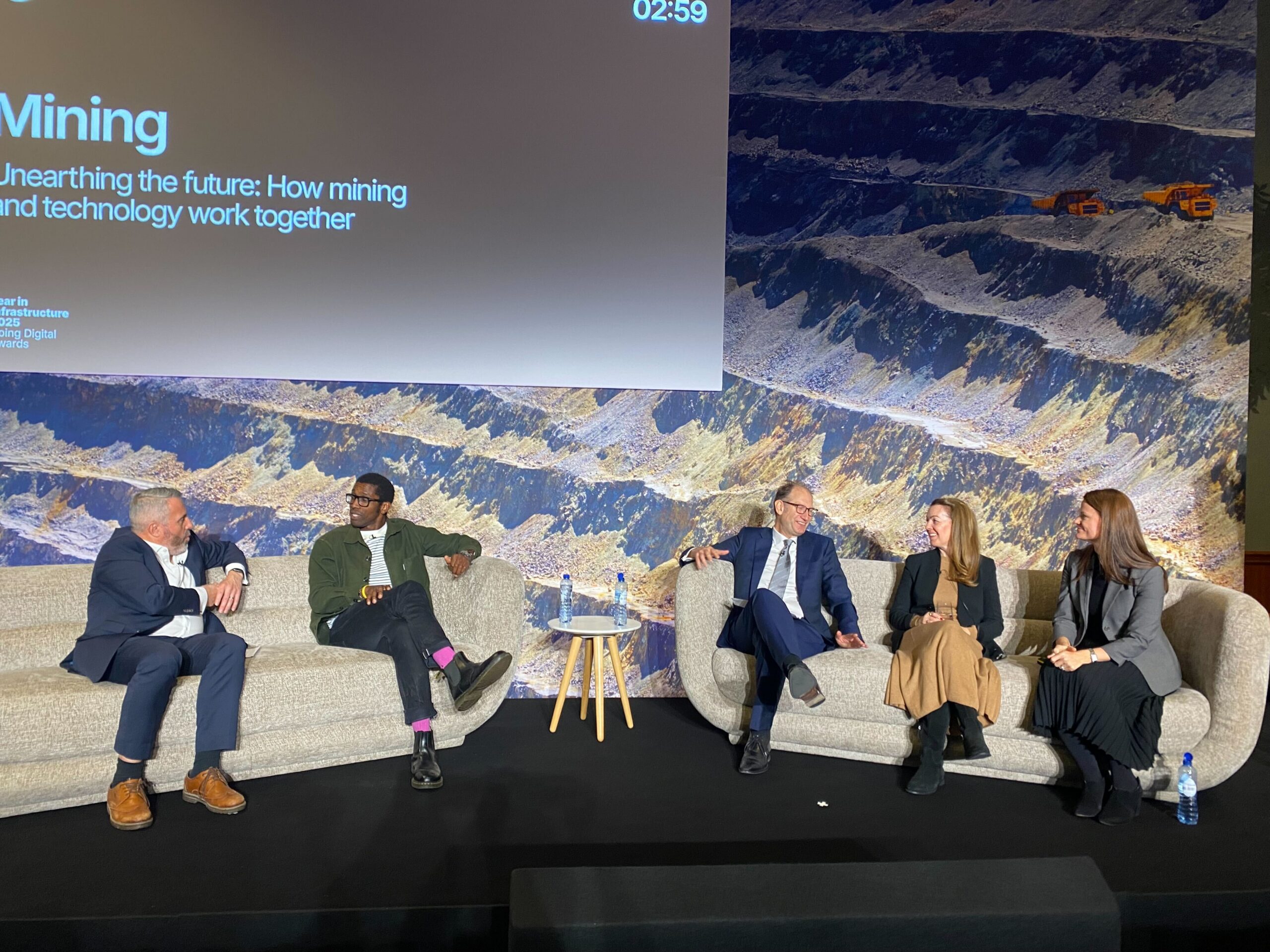
From left to right: Mark Campodonic, Chris Jackson, David Skilling, Liv Carroll, and Angela Harvey, Bentley’s Year in Infrastructure, October 2025
Source: Bentley Systems
The innovation imperative: From tankers to speedboats
‘Mining has not been the fastest industry to innovate. It’s like a big old tanker; you turn the wheel and it takes time to shift,’ Carroll said. But this is changing with modern innovation, agile technology development and a change in how we think and work. At Seequent, we have seen this tension firsthand; the desire to innovate balanced against factors such as legacy systems and traditional ways of working. But once innovation and adaptability takes root, the result can be transformational.
Campodonic pointed out, ‘The easy deposits — high-grade, near-surface — have been found and mined. Now we face deeper, lower-grade deposits that require new methods and smarter decision-making.’ The need to make marginal projects viable, while meeting sustainability and ESG expectations, demands that technology, from AI to cloud-based geoscience platforms, becomes central to how value is created and communicated.
Lessons from oil and gas: Reimagining data’s potential
Jackson drew parallels with the oil and gas industry, which has long used scalable innovations such as seismic surveys, to better understand the subsurface and make informed decisions. ‘Think of seismic data as a CT scan of the Earth,’ he said. ‘It lets you understand what’s down there before committing people to the job.’ But Jackson also offered a provocative idea: Mining could look backward, not just forward. ‘Oil and gas companies have collected decades worth of borehole data. Use of this data by the mining sector could help us better understand near-surface environments and unlock new opportunities sustainably.’ One person’s trash can truly be another person’s treasure.
Carroll pointed out that investors typically want the industry to use proven technology, however ‘if we are going to innovate, stakeholders need to be more comfortable with new techniques applied to the industry including utilising technology from other sectors.’ And this is despite the scepticism that often accompanies innovation, said Campodonic. When Leapfrog software was first introduced in 2004, ‘people didn’t trust what it was producing. It felt like a black box,’ he recalled. ‘Now it’s the software of choice for geological modelling across the mining industry.’
In January 2025, Kingdom of Saudi Arabia’s oil and gas company, Aramco and Ma’aden, a multi-commodity mining company, announced a joint venture aimed at advancing the Kingdom’s capabilities in extracting transition minerals, particularly lithium.
Building the workforce of the future
With an ageing workforce, declining enrolment in the earth sciences and a growing skills gap, who will power mining’s future? The International Energy Agency estimates the mining industry must double its skilled workforce by 2040 to meet critical mineral demand. How do we get our children to choose a career path in mining? Jackson argued that it’s all in our message to younger audiences. ‘If you want to have a positive impact on the world, from sustainable energy to resource stewardship, geoscience is the place to be,’ he said. Even more practically, ‘we need to talk about the career longevity and security. It is something that will put food on the table and a roof over your head,’ not to mention the perks of travel.
Campodonic added: ‘We need to change perceptions. Geology isn’t just fossils and volcanoes, high-viz vests and hard hats.’ The next generation is digitally native and data science, automation and AI is the language they already speak. If we can show them that a career in mining means shaping a sustainable future, working with advanced technology, and making a real-world impact, then it becomes a path worth choosing.
Seequent’s Visible Geology aims to demonstrate to both students and educators not only the importance but the reward of pursuing a career in geoscience
AI and the human factor
Few topics stir as much debate as artificial intelligence. From core logging automation to predictive modelling, AI’s potential is immense and continues to expand the possibilities in the mining industry. Campodonic noted that advanced algorithms now help geoscientists quickly identify mineral hotspots, streamlining exploration workflows and enabling informed decisions earlier in the project lifecycle. Real-world examples such as this demonstrate ‘AI used with purpose, critical to getting stakeholder buy-in’, said Jackson.
Deloitte reports that 77% of mining executives believe AI will significantly transform operations within five years, but only 26% feel fully prepared.
‘AI is a fantastic tool to remove mundane tasks,’ explained Carroll, ‘freeing up brilliant minds to focus on what they’re trained and experienced to do, and apply their geoscience smarts.’ Carroll cautioned, however, that while efficiency gains are vital, there is no substitute for human intuition and expertise, especially in complex or high-stakes situations where context and judgement matter. Angela Harvey summed it up well: ‘Having a human in the loop, someone to validate and approve outcomes, helps build trust in AI-driven processes.’
Mining’s social licence: changing the narrative
Despite its economic and strategic importance, mining is still viewed negatively by the public. ‘Mining has a PR problem,’ Carroll admitted. ‘It’s rooted in both reality and perception, in past harm, and in the disconnect between people’s understanding of where their products come from.’ Rebuilding trust starts with listening. ‘Nobody wants to do that because it takes longer. But listening first, before the first boots hit the ground, makes all the difference,’ said Jackson.
Said Carroll, ‘There are vast amounts of time and energy invested by mining companies to operate responsibly and ensure benefits to local communities.’ But the good stories rarely make the news, and this is how the idea of ‘not in my backyard’ can perpetuate. Whether it’s Samuel L. Jackson or Taylor Swift that may resonate as an admired spokesperson, or simply trusted public engagement, ‘if people consider a process to be fair, they are more likely to accept the outcome, even if they don’t agree with it’, said Carroll.
A future forged in collaboration
Mining’s next chapter won’t be written by any one company or technology — but by collaboration across disciplines, sectors, and geographies. As Harvey concluded, ‘‘The opportunities are immense if we can work together — integrating new technologies, new ways of thinking, and a shared commitment to responsible growth.’’
Seequent’s role in bringing together geoscience, data, and innovation can help the industry not only adapt to change but lead it. The future of mining is collaborative, intelligent, and full of promise.
Explore Seequent’s mining solutions
Learn more